
Travelling by bus or coach :Cross Stitch – Disabled people

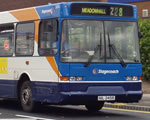
Buses and coaches are becoming increasingly accessible to disabled people, especially wheelchair users. Learn more about what changes are being made to increase accessibility and find out about free travel for disabled people.
New buses and coaches designed to carry more than 22 passengers on local or scheduled services must comply with Public Service Vehicles Accessibility Regulations (PSVAR).
All buses and coaches, both old and new, need to comply with the PSVAR by the following dates:
- 1 January 2024 – all buses must comply with the accessibility regulations
- 1 January 2024 – all coaches must comply with the accessibility regulations
Regulations for England, Scotland and Wales
The PSVAR ensure public service vehicles are accessible to disabled people. They are the responsibility of the Department for Transport’s Buses and Taxis Division.
Regulations for Northern Ireland
Northern Ireland has separate regulations; the Department for Regional Development is responsible for these.
You can read more about PSVAR by following the links below.
By 1 January 2024 most wheelchair users will be able to travel on buses. And most wheelchair users will be able to travel on coaches by 1 January 2020. But you may find you can’t if:
- your chair is very heavy or very big (taking up a space – when you are in it – of more than 700 mm wide or 1200 mm long)
- you need to travel with your legs fully extended or the backrest reclined
Before you travel
You must ensure that your wheelchair is in a safe condition to travel. This means, for example, making sure that it is properly maintained etc. If you have a powered chair you must ensure that the battery is secure. If your chair has adjustable kerb climbers you should check that they are set so that they do not catch on the ramp.
The transport operator has the right to refuse to let you travel if they believe that your wheelchair is not in a safe condition.
It is important to check whether your wheelchair can be carried by the bus or coach operator before you travel.
Further advice on taking a wheelchair on public transport can be found on the Ricability website.
While travelling
You must make sure your wheelchair brakes are on. If you use a powered wheelchair then you should make sure the power is switched off.
By January 2017, there’ll be space designated for wheelchair users on buses, and on coaches by 1 January 2020. For example, buses and coaches designed to carry more than 22 passengers on local or scheduled services will be within the scope of the PSVAR.
Buses and coaches will require:
- a forward facing wheelchair space fitted with a wheelchair restraint system
- wheelchair user restraint
On buses designed to carry standing passengers the wheelchair space may be a rearward facing protected area. This will be fitted with a padded head and back restraint. The area will also have a vertical stanchion or retractable arm to prevent the wheelchair from slewing into the gangway.
Mobility Scooters
You should contact your local operator to find out whether or not your scooter is transportable on their buses and coaches before you travel.
Bus and coach drivers are required by law to provide reasonable assistance to disabled people. In particular to help them get on and off the bus or coach. This does not extend to physically lifting passengers or heavy mobility equipment. If you need help to get on and off a coach, you should ask for this when you book your ticket.
If you need assistance at the coach station, contact either the station or the coach company before you travel. Let them know what help you will need.
Induction loops
Many ticket office windows have induction loops to help people who have a hearing aid. These windows are clearly marked. Phones at many stations are also fitted with devices to help people who have a hearing aid.
Support and assistance dogs
You can take support and assistance dogs into station buffets and restaurants, and onto coaches.
Accessible toilets
Many coach stations have accessible toilets. Some operate under the National Key Scheme (NKS), which enables disabled people to use accessible public toilets independently by using their own NKS key. You can buy an NKS key from RADAR.
Some coaches have toilets on board. If you can’t access the toilet on a long-distance coach journey, the driver should stop at coach stations so you can use the toilets. For instance, the toilet is situated down some steps.
For many disabled people who have not travelled by public transport, the thought of travelling on trains, buses or trams can be frightening.
A number of local authorities are introducing ‘travel training’ schemes to help disabled people gain confidence when travel independently.
The Department for Transport offer more information on travel training schemes.